
To successfully complete the hands-on portions of this module, students should have access to:
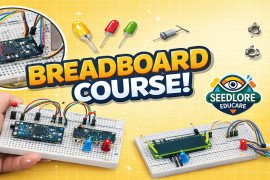
Hardware: An Arduino-compatible microcontroller (Uno/Mega), a Breadboard, and basic jumper wires.
Actuator Kit: Standard DC motor, SG90 Servo motor, 3-pin Active Buzzer, Submersible Water Pump, and a 7-Segment LED display.
Power Electronics: An external power source (9V battery or 12V adapter) and a Relay module or Transistor (TIP120) for high-current components.
Software: Arduino IDE installed on a computer.
Prerequisite Knowledge: Basic understanding of "Input vs. Output" and familiarity with simple C++ coding (variables and digital logic).
This course provides an in-depth exploration of how robots interact with the physical world. While sensors act as the "eyes," actuators serve as the "muscles," converting electrical, fluid, or thermal energy into physical movement, sound, and light.
Students will journey through the diverse world of motion, from the high-speed rotation of DC motors to the surgical precision of Stepper motors and the incredible strength of Hydraulic systems. The course also covers essential "non-moving" actuators like Buzzers and LED displays, LED matrices and LCDs, which are critical for Human-Robot Interaction. By the end of this module, learners will not only understand the theory behind these components but also the practical safety and circuitry required to integrate them into real-world projects like Smart Dustbins and Adaptive Streetlights.
By the conclusion of this module, students will demonstrate mastery in the following areas:
1. Actuator Categorization & Selection
2. Electromechanical Principles
3. Safe Circuit Interfacing
4. Precision Signal Control
5. Human-Robot Interaction (HRI)
6. System Troubleshooting & Maintenance

NCERT Certified in Robotics & AI
Actuators
No Review found