
To effectively understand this module, learners should have:
Basic Knowledge Requirements
Fundamental understanding of electricity (voltage, current, resistance)
Basic circuit components (resistors, sensors, microcontrollers)
Introductory knowledge of robotics concepts
Technical Skills (Recommended but Not Mandatory)
Basic Arduino or ESP32 familiarity
Understanding of analog and digital signals
Basic programming knowledge (C/C++ or block-based coding)
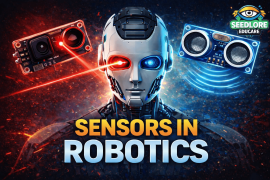
This lesson explores the different types of sensors commonly used in robotics systems. Each category is explained with:
Clear conceptual overview
Common sensor examples
Real-world applications
Functional importance in robotic systems
The module covers:
Vision Sensors
Tactile Sensors
Temperature Sensors
Range & Proximity Sensors
Motion & Position Sensors
Navigation & Orientation Sensors
Sound & Speech Sensors
Students will learn how each sensor contributes to robot intelligence and how multiple sensors are often combined to build autonomous systems.
By the end of this module, learners will be able to:
Define the role of sensors in robotics.
Classify sensors based on function.
Explain the working principle of common robotics sensors.
Identify appropriate sensors for specific robotic applications.
Understand how sensors improve safety, accuracy, and automation.

NCERT Certified in Robotics & AI
Sensors in Robotics – Foundation Course
No Review found