
To ensure success in this course, students should have:
Basic Electronics: Familiarity with Voltage (V), Current (I), and Resistance (R).
Component Knowledge: A basic understanding of LEDs, resistors, and breadboarding.
Microcontroller Basics: Previous experience with Arduino, ESP32, or similar platforms (specifically handling Analog and Digital pins).
Mathematical Foundation: Comfort with simple algebraic comparisons (e.g., V+ > V- logic).
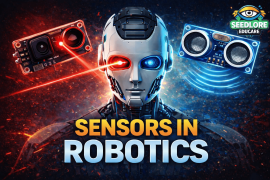
This course provides a comprehensive deep dive into the fundamental components that allow a robot to perceive and interact with its environment. Students will explore the physics, electronics, and signal processing behind critical sensors and the internal mechanics of various Capacitors (Aluminium, Ceramic, Tantalum). Through a blend of theoretical principles and hardware analysis, participants will learn to interface sensor adapter boards with microcontrollers using ICs like the LM393 comparator and LM358 Op-Amp. By the end of the course, students will be able to design stable, noise-free robotic systems capable of precise environmental monitoring.
By the end of this course, students will be able to:
Identify and Explain the internal and external components of optical sensors and adapter boards.
Analyze Circuitry: Understand the role of signal processing ICs (LM393/LM358) in voltage comparison and signal amplification.
Select Hardware: Differentiate between Aluminium, Ceramic, and Tantalum capacitors based on energy storage, stability, and ESR requirements.
Troubleshoot Systems: Use power and signal LEDs to diagnose hardware connectivity and power stability issues.
Implement Calibration: Adjust potentiometers and reference voltages to set digital triggers for real-world robotic tasks.

NCERT Certified in Robotics & AI
Capacitors
No Review found